


Glaiter OS
Preview of an Operating System for AI Agents
The morning my disk told me it was leaving.
For two weeks, an agent has been reading the system log on my machine. Not me — nobody reads logs. Around 3,500 new lines a day, and somewhere in there, the disk started quietly collecting damaged sectors. The agent noticed. It decided that mattered, wrote a detection rule by itself so the same warning never needs thinking about again, and put it on my dashboard — weeks before I would have noticed anything.
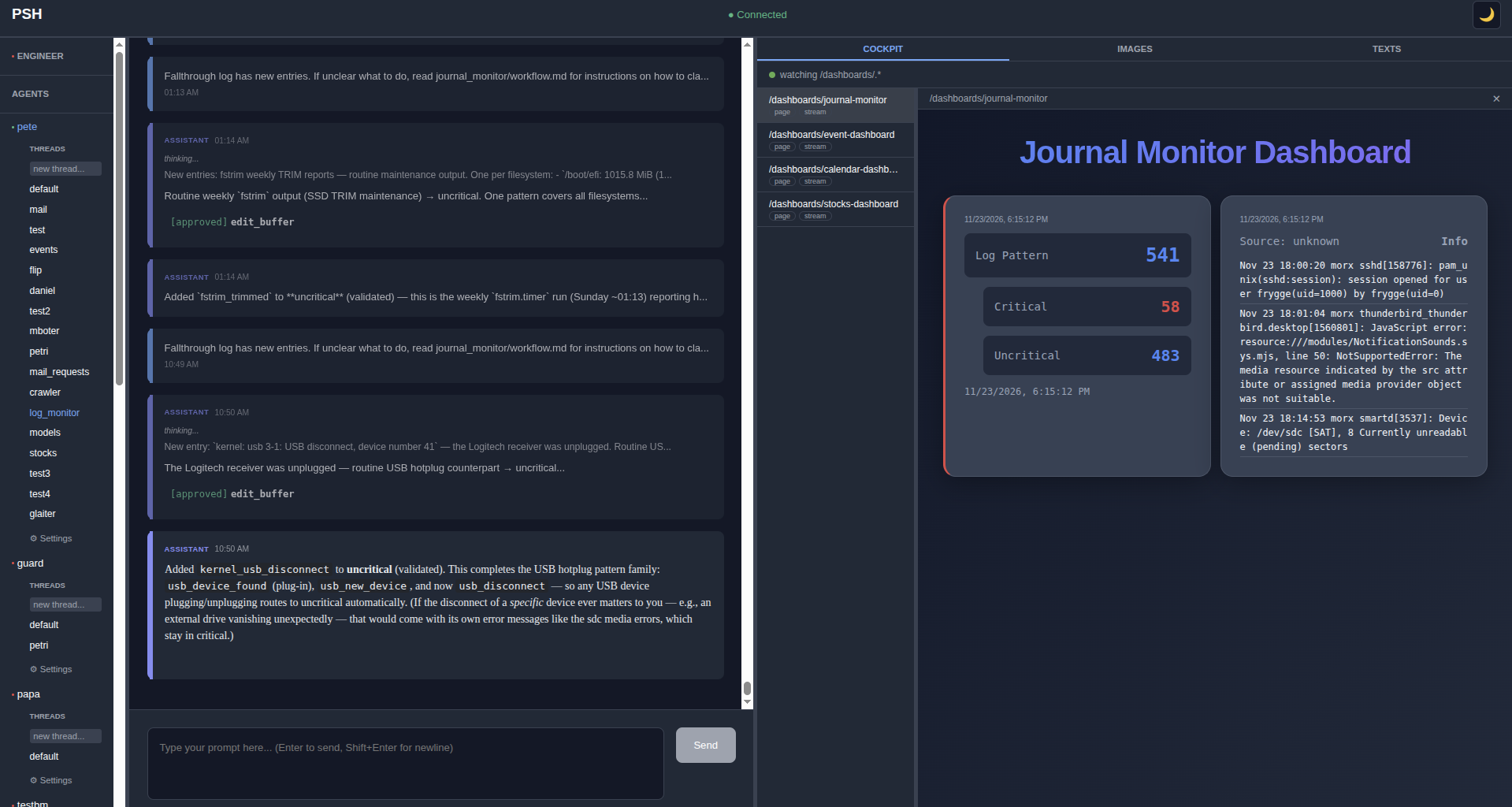
Preview of Glaiter Tower
The log-monitor agent at work: tower sessions on the left, the agent classifying new log lines — with human-approved edits — in the center, and the resulting cockpit dashboard on the right. That agent isn't the point. The point is what it runs on.
Not another agent — the thing agents run on
There are plenty of agentic systems out there: chatbots with tools, models in the middle of everything, busy and expensive. Glaiter OS is different: it is not an agentic system — it is an operating system for agents. It runs your processes and brings in intelligence exactly where it earns its keep. The language model is not the center of it; your software is.
What that means for you
- You pay for judgment, not for chatter. In our own log-watching setup, an agent made 508 decisions to handle more than 42,000 events — roughly 50 times less than a bot that reasons about every single message. Every decision is remembered and reused, so the system gets cheaper the longer it runs.
- Your code stays your code. Glaiter OS works with ordinary Python objects. You make existing classes agentic — no rewrite, no framework tax. Whatever can stay deterministic, stays deterministic — and is tested like normal software.
- Trust is built in, not bolted on. Policies define what agents may do. When a decision is unclear, the agent asks a human instead of guessing. And because agents live as objects, you debug and test them like any other software.
- You stay in control. Every agent gets its own cockpit — live dashboards you watch from the tower, the way an air-traffic controller watches gliders. Agents fly; you own the airspace.
Already at work today
A log-watching agent that caught a failing hard drive — and writes its own detection rules as new kinds of messages appear. An agent that crawls event listings for our startup once a day and puts them on a dashboard. It was set up in a conversation and has run on its own ever since. A robot that cruises on a deterministic controller while an agent pilots it — stepping in only when it bumps into a wall.Early, but real
Glaiter OS is young, and we're publishing it right now. It is already daily-drivable, and it is already valuable: agents that don't cost a fortune, that you can test, that help build their own processes with you in plain language — and that ask before they do something risky.
pip install peteos   # the core
pip install petekit  # the building blocks
Core: github.com/Schafer-List-Systems/peteos
Building blocks: github.com/Schafer-List-Systems/petekit
The frontend will be following soon
An operating system for agents — because an agentic system is something you build. This is what you build it with.
Get in touch